


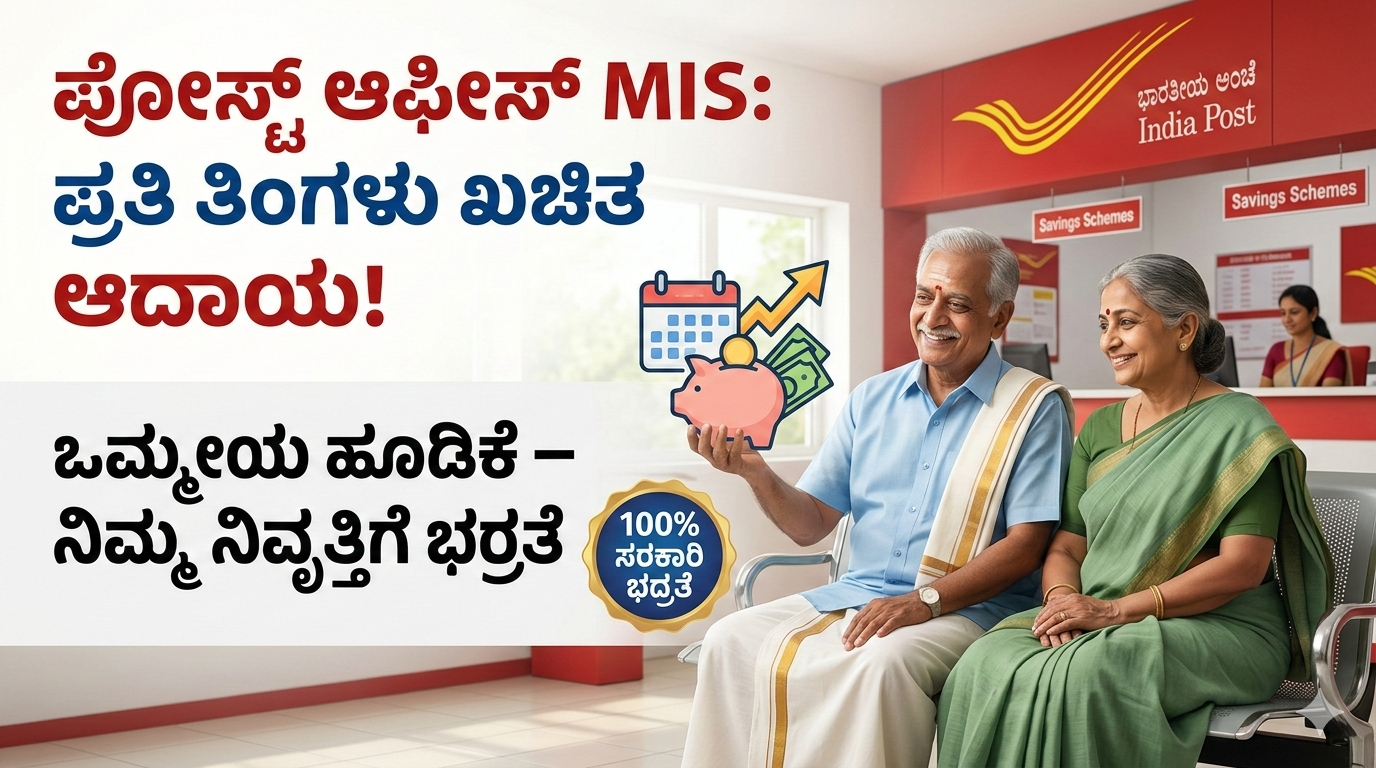
Post Office Monthly Income Scheme (MIS) 2026: A Comprehensive Guide to Guaranteed Monthly Returns
In an era of volatile stock markets and fluctuating interest rates, the quest for a safe haven for one’s hard-earned money never ends. For many Indian households, the priority isn’t just growth, but capital protection combined with a steady cash flow. Whether you are a retiree looking for a “monthly salary” or a family planner aiming to cover recurring expenses like school fees or EMIs, the Post Office Monthly Income Scheme (MIS) stands out as one of the most reliable financial instruments offered by India Post.
This detailed guide explores every facet of the Post Office MIS in 2026, helping you decide if this government-backed scheme is the right fit for your portfolio.
What is the Post Office Monthly Income Scheme (MIS)?
The Post Office MIS is a low-risk, government-backed savings scheme that allows individuals to deposit a lump sum amount for a fixed tenure of 5 years. In exchange, the government pays out interest every month, providing a fixed supplementary income.
Unlike a Fixed Deposit (FD) where interest is usually compounded or paid at maturity, the MIS is specifically designed to provide liquidity every month. At the end of the 5-year term, your initial deposit (the principal) is returned to you in full.
Why Choose MIS?
-
Sovereign Guarantee: Since it is backed by the Government of India, your capital is 100% secure.
-
Predictability: The interest rate is locked in at the time of deposit for the entire 5-year duration.
-
Passive Income: It acts as a reliable source of monthly funds without the need for active management.
Eligibility: Who Can Invest?
The scheme is designed to be inclusive, catering to various demographics across India:
-
Adults: Any resident Indian above the age of 18 can open an account.
-
Joint Holders: Up to three adults can open a joint account. In a joint account, all holders have an equal share in the investment.
-
Minors: Parents or legal guardians can open an account on behalf of a minor. Minors above the age of 10 can also operate the account in their own name.
-
-
NRIs: Unfortunately, Non-Resident Indians are not eligible to open a new Post Office MIS account.
Investment Limits and Returns (2026 Update)
-
The government periodically reviews the interest rates for small savings schemes. Currently, the rate stands at an attractive 7.4% per annum, paid out monthly.
Deposit Limits
To ensure the scheme benefits the common man and prevents hoarding by high-net-worth individuals, the government has set the following limits:
-
Single Account: Maximum investment of ₹9,00,000.
-
Joint Account: Maximum investment of ₹15,00,000.
The “Double Benefit” Strategy: MIS + RD
A smart way to maximize your wealth is the MIS-RD Combo. Instead of spending the monthly interest earned from your MIS account, you can set up an Automatic Transfer to a Post Office Recurring Deposit (RD).
By doing this:
-
Your principal stays safe in the MIS.
-
Your monthly interest is reinvested in an RD.
-
You earn “interest on interest,” significantly increasing your total corpus at the end of 5 years.
Premature Withdrawal Rules
While the scheme has a 5-year lock-in period, life is unpredictable. If you need to withdraw your money early, the following rules apply:
-
Before 1 Year: No withdrawal allowed.
-
Between 1 to 3 Years: You can withdraw, but a 2% deduction is made from your principal as a penalty.
-
Between 3 to 5 Years: A 1% deduction is made from your principal.
-
After 5 Years: Full principal is returned with no deductions.
How to Apply for Post Office MIS
Opening an MIS account is a straightforward process that requires a physical visit to your local post office.
Documents Required:
-
Identity Proof: Aadhaar Card, Voter ID, or Passport.
-
Address Proof: Electricity bill, Ration card, or Aadhaar.
-
Photographs: Two recent passport-size photos.
-
PAN Card: Mandatory for financial transactions.
- Savings Account: You must have a Post Office Savings Account to facilitate the monthly interest credit.
Step-by-Step Process:
-
Visit: Go to your nearest CBS-enabled Post Office.
-
Form: Collect the MIS application form (Form 1).
-
Nomination: Ensure you fill in the nominee details to secure your family’s future.
-
Deposit: Hand over the cheque or cash (for smaller amounts) for the initial deposit.
-
Activation: Once processed, you will receive a passbook with your MIS details.
Tax Implications
It is important to note that the Post Office MIS does not offer tax benefits under Section 80C.
The monthly interest you receive is considered part of your taxable income and will be taxed according to your applicable income tax slab.
However, there is no TDS (Tax Deducted at Source) at the post office level, making it easier for those in lower tax brackets to manage their cash flow.
Conclusion
The Post Office Monthly Income Scheme remains a cornerstone of conservative financial planning in India. In 2026, with the cost of living rising, having a guaranteed monthly check of ₹9,250 (on a max joint deposit) can provide immense mental peace. It is an ideal bridge for those transitioning into retirement or for families looking to automate their monthly utility bills through investment returns.

